
Safety of Household, Commercial and Similar Electrical Appliances
Commercial Electric Cooking Ranges, Ovens, Hobs and Hob Elements
Strategic Recommendations for Commercial Electric Cooking Ranges, Ovens, Hobs and Hob Elements — IS 302 (Part 1): 2024
Start BIS Certification in Advance of Deadlines
Manufacturers and importers should initiate BIS certification under Scheme-I well before the phased enforcement dates (1 October 2026 / 1 January 2027 / 1 April 2027) to accommodate testing, inspection, and approval timelines.
Engage ERA Compliance, Experts
ERA’s compliance team provides end-to-end support for BIS certification, including application filing, coordination with BIS-recognised laboratories, factory audit readiness, corrective action support, and ISI marking approval to ensure smooth and timely compliance.
Reach Out for Support
For product eligibility checks, documentation guidance, and certification timelines, stakeholders may directly connect with ERA’s compliance team.
📧 cs@eraglobal.co.in | 📞 +91 9599296331 | 💬 WhatsApp Support Available
Track Gazette Notifications and Amendments
Stay updated on future Government notifications, BIS amendments, and enforcement changes by regularly tracking Gazette publications and subscribing to the ERA Newsletter for timely regulatory alerts and compliance updates.
Ensure ISI Marking and Product Compliance Control
Only BIS-certified commercial electric cooking appliances conforming to IS 302 (Part 1): 2024 and bearing the ISI Mark should be manufactured, imported, or sold in India. Non-certified or transitional stock must be strictly segregated and managed as per the notified provisions.
| Section | Details |
|---|---|
| Product Name | Commercial Electric Cooking Ranges, Ovens, Hobs and Hob Elements |
| Applicable Indian Standard (IS) No. | IS 302 (Part 1): 2024 / IEC 60335-1:2020. |
| Title of Indian Standard | Household and Similar Electrical Appliances — Safety — Part 1: General Requirements. |
| Notification & Amendments | Safety of Household, Commercial and Similar Electrical Appliances (Quality Control) Order, 2026 – S.O. 1739(E), dated 6 April 2026, issued by DPIIT, Ministry of Commerce and Industry; supersedes the Safety of Household, Commercial and Similar Electrical Appliances (Quality Control) Order, 2025. |
| Enforcement Date (Category-wise) | General Enterprises: 1 October 2026; Small Enterprises: 1 January 2027; Micro Enterprises: 1 April 2027. |
| Objective & Scope | To ensure safety, performance, and protection against electrical, thermal, and mechanical hazards for commercial electric cooking equipment used in kitchens and food service establishments. Covers appliances operating within prescribed voltage limits and intended for commercial or similar use environments. |
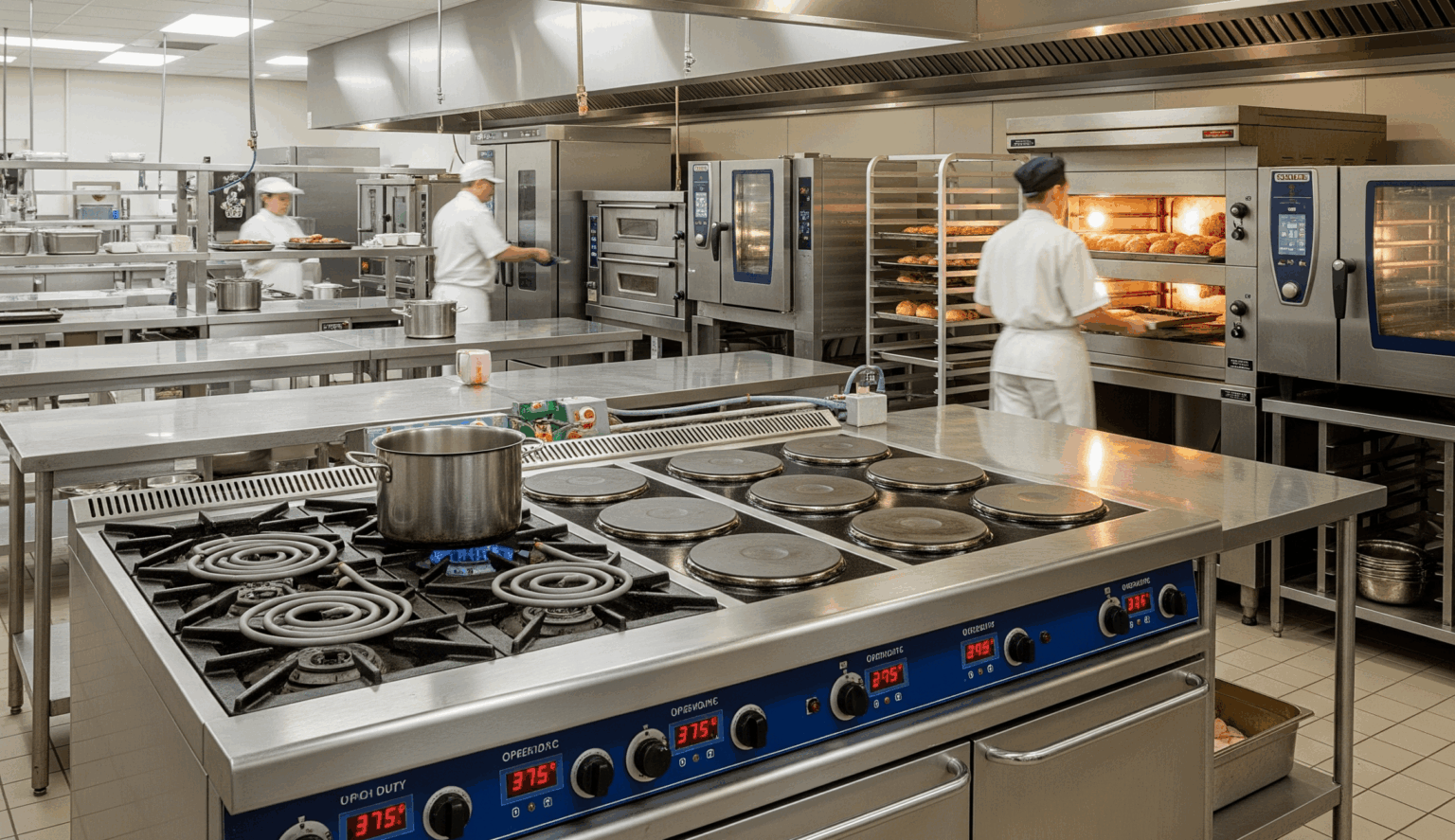
| Products Covered | Commercial electric cooking ranges, ovens, hobs, hob elements, and similar electrically operated cooking appliances are used in commercial kitchens, hotels, restaurants, catering units, and food processing environments. |
| Exemptions | Products manufactured exclusively for export; up to 200 units per year imported for R&D purposes (non-commercial use); declared pre-implementation stock allowed for sale up to six months, subject to BIS declaration conditions. |
| Special Coverage | Includes appliances powered by AC, DC supply, or battery-operated systems within specified voltage limits; excludes products already covered under other QCOs or notified separately under BIS mandatory certification. |
| Industries Impacted | Commercial Kitchen Equipment Manufacturers, Hospitality & Catering Industry, Restaurant Chains, Institutional Canteens |
| Mandatory Compliance | Products must conform to IS 302 (Part 1): 2024 and bear the ISI Mark under a valid BIS licence (Scheme-I) before manufacture, import, or sale in India. |
| Next Steps for Stakeholders | Identify applicable product categories; initiate BIS certification; conduct testing through BIS-recognised labs; ensure factory compliance and inspection readiness; obtain BIS licence; implement ISI marking; align inventory before enforcement deadlines. |
| Certification, Enforcement & Legal Framework | Certification and enforcement by the Bureau of Indian Standards (BIS) under Sections 16, 17, and 25(3) of the BIS Act, 2016; compliance through Scheme-I of BIS (Conformity Assessment) Regulations, 2018. |
| Penalties for Non-Compliance | Imprisonment up to 2 years under the BIS Act, 2016, Monetary fine not less than ₹2 lakh, extendable up to ten times the value of goods, Additional penalties for continued non-compliance, and seizure of non-certified goods. |
| Amendment Clause | The latest version of IS 302 (Part 1), including amendments notified by BIS from time to time, applies automatically from the date of such notification. |
| Conclusion | BIS certification is mandatory for commercial electric cooking appliances from the notified dates. Early compliance ensures uninterrupted operations in commercial food service sectors and avoids regulatory and operational risks. |
| References/Annexures | Gazette Notification S.O. 1739(E) dated 6 April 2026; BIS Act, 2016; BIS (Conformity Assessment) Regulations, 2018; IS 302 (Part 1): 2024. |
Notification
Commercial Electric Cooking Ranges, Ovens, Hobs, and Hob Elements have been brought under mandatory quality control through the Safety of Household, Commercial and Similar Electrical Appliances (Quality Control) Order, 2026, notified vide S.O. 1739(E) dated 6 April 2026 by the Department for Promotion of Industry and Internal Trade (DPIIT), Ministry of Commerce and Industry. This Order supersedes the earlier 2025 framework, while retaining continuity for prior actions. The regulation mandates compliance with IS 302 (Part 1): 2024, aligned with IEC 60335-1:2020, ensuring harmonization with international safety standards.
Overview
The regulation establishes a comprehensive safety framework for commercial electric cooking equipment used in professional environments such as restaurants, hotels, catering units, and institutional kitchens. IS 302 (Part 1): 2024 defines critical safety parameters, including electrical insulation, temperature rise limits, mechanical strength, protection against electric shock, and safe operation under normal and abnormal conditions. The objective is to eliminate unsafe and substandard appliances from the market while ensuring consistent product reliability in high-usage commercial environments.
Objective & Scope
The primary objective is to ensure the safety of users, prevent fire and electrical hazards, and standardize the quality of commercial cooking appliances across India. The scope covers the manufacture, import, sale, and distribution of commercial electric cooking ranges, ovens, hobs, and associated components operating within specified voltage limits. Appliances falling under other QCOs or separate regulatory frameworks are excluded, ensuring clarity in regulatory applicability.
Products Covered
The coverage includes a wide range of commercial electric cooking equipment, such as cooking ranges, ovens, hobs, hob elements, and similar appliances designed for intensive usage in commercial kitchens. These products are typically used in hospitality establishments, food processing units, and large-scale cooking operations, where safety and durability are critical due to continuous and high-load usage.
Exemptions Provided
Limited exemptions are available under the Order, including products manufactured exclusively for export, R&D imports up to 200 units per year (subject to non-commercial use), and declared pre-implementation stock which may be sold for up to six months post-enforcement date upon submission of a certified declaration. These provisions aim to balance regulatory enforcement with operational flexibility.
Industries Impacted
The regulation directly impacts manufacturers of commercial kitchen equipment, OEM suppliers, importers, distributors, and businesses operating in the hospitality and food service sectors. Hotels, restaurants, cloud kitchens, catering companies, and institutional kitchens will also be affected, as procurement must be restricted to BIS-certified equipment only.
Mandatory Compliance Requirements
Manufacturers and importers must obtain BIS certification under Scheme-I, conduct product testing in BIS-recognised laboratories, ensure factory quality control systems meet prescribed standards, and affix the ISI Mark on compliant products. Only certified products can be legally manufactured, imported, or sold in India after the enforcement dates.
Enforcement Timeline
As per the notified implementation schedule, mandatory compliance will apply from 1 October 2026 for general enterprises, 1 January 2027 for small enterprises, and 1 April 2027 for micro enterprises. These staggered timelines provide transitional relief for MSMEs while ensuring progressive enforcement across the industry. Manufacturers and importers must align certification timelines well in advance to avoid disruption in supply chains, particularly in the commercial kitchen and hospitality sectors.
Next Steps for Stakeholders
Stakeholders should immediately identify covered product categories, initiate BIS certification processes, coordinate testing and inspections, and align production systems with IS requirements. Early planning is essential to ensure a seamless transition before enforcement deadlines and to avoid supply disruptions in commercial operations.
Legal Provisions & Penalties
Certification and enforcement are administered by the Bureau of Indian Standards (BIS) under Sections 16, 17, and 25(3) of the BIS Act, 2016. Non-compliance attracts strict penalties, including imprisonment up to two years, fines starting from ₹2 lakh and extending up to ten times the value of goods, and additional penalties for continued violations, along with possible seizure of non-compliant products.
Conclusion
Compliance with IS 302 (Part 1): 2024 and BIS certification is mandatory for commercial electric cooking appliances from the notified enforcement dates. Timely compliance ensures legal market access, enhances product safety credibility, and minimizes regulatory risks for stakeholders in the commercial kitchen equipment sector.
Ready to start your certification journey?
Let us help you navigate regulatory challenges and achieve certification with ease. Leave us your details, and we’ll get back to you—or request a free consultation today.