
BIS CRS Update 2026: New Classification for Audio, Smart, AR & MR Glasses and VR Headsets
Introduction
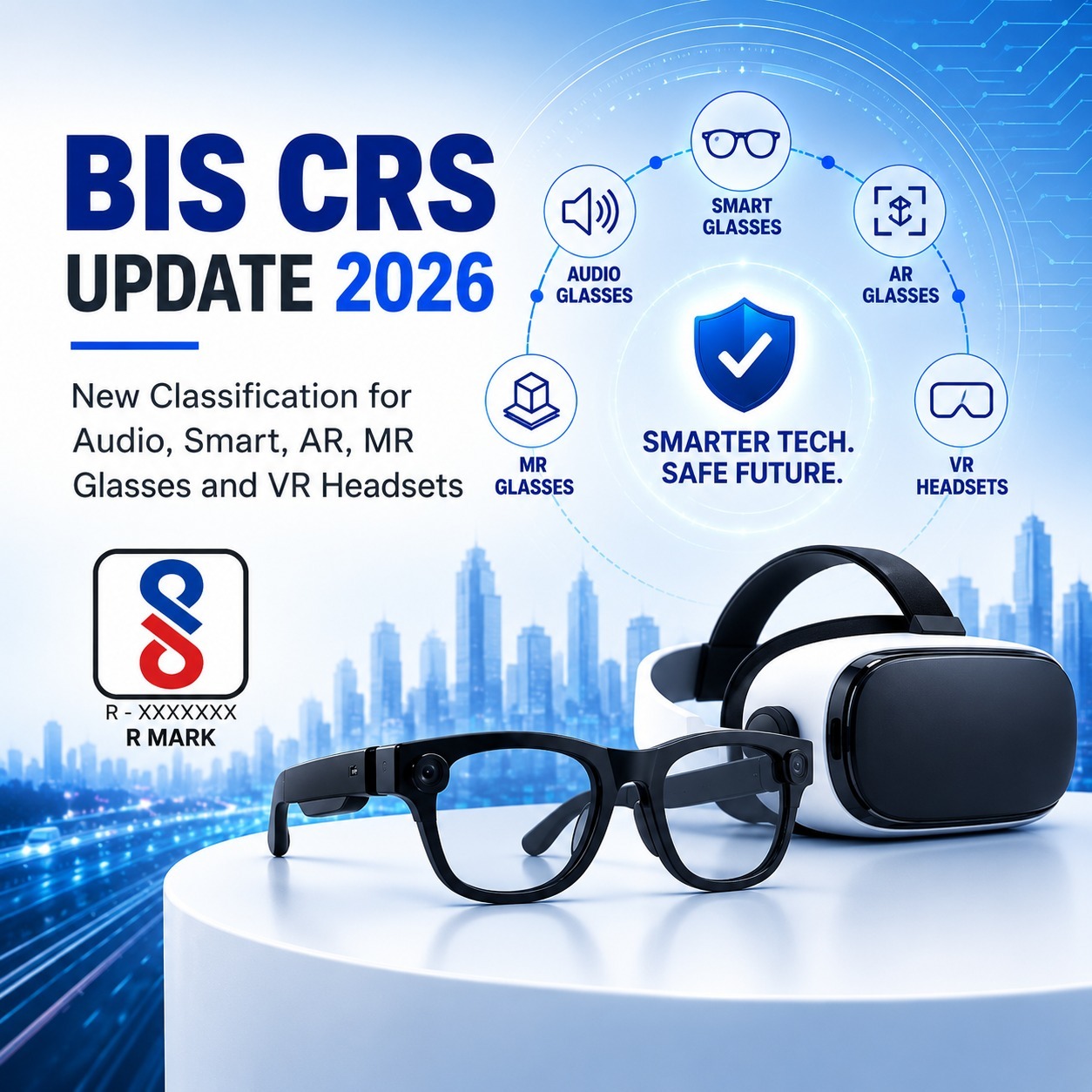
The BIS CRS Update 2026 provides clearer classification guidance for Audio Glasses, Smart Glasses, AR Glasses, MR Glasses and VR Headsets.
A pair of smart glasses may look simple, but its regulatory classification can depend on what it does. The BIS CRS update 2026 brings greater clarity to how wearable glasses and Extended Reality products are classified in India. On 13 August 2026, the Bureau of Indian Standards (BIS), Registration Department, issued guidance on product categories under the Compulsory Registration Scheme (CRS). The guidance identifies specific categories, sub-categories and product names for wearable and Extended Reality products.
For manufacturers, exporters and technology businesses, this development matters because modern eyewear can combine wireless connectivity, audio, cameras, artificial intelligence and display functions. A small change in functionality can therefore affect how a product is viewed under the applicable BIS framework.
Why Product Classification Matters in Global Trade
Product certification plays an important role in international trade. Regulatory authorities use defined categories to assess whether products meet applicable requirements before entering a market.
For technology manufacturers, classification can become more complex when one device combines several functions. Audio glasses, camera-enabled smart glasses and glasses with display overlays may appear similar but have different characteristics.
The latest BIS guidance provides a clearer reference for these products under the Electronics and Information Technology Goods (Requirement of Compulsory Registration) Order, 2021.
This is particularly relevant for businesses that manufacture or export connected wearable products to India.
BIS CRS Classification for Wearable Glasses
The Government guidance identifies four main wearable glasses classifications in its first table.
Product Category | Sub-category | Product Name |
Wireless Earphones and Headphones | Audio Glasses | Audio Glasses |
Digital Camera | Smart Glasses | Smart Glasses |
Video Camera | Smart Glasses | Smart Glasses |
Extended Reality Products | AR Glasses | AR Glasses |
Extended Reality Products | MR Glasses | MR Glasses |
The guidance states that Audio Glasses may include Bluetooth or other wireless connectivity, microphones, speakers, audio calling, music playback and similar functions, including an AI-based voice assistant.
For Smart Glasses, the classification differs according to camera capability. Products capable of capturing photographs only fall under Digital Camera, while products capable of capturing both photographs and videos fall under Video Camera.
BIS Certification for Smart Glasses and New Wearable Categories
The classification of connected eyewear is important because product functionality can influence the applicable regulatory category.
For businesses researching BIS certification for smart glasses, the distinction between camera capabilities is particularly significant. Two products may have similar physical designs while having different classifications because their recording functions differ.
The guidance also identifies AR Glasses under Extended Reality Products. These products may have Smart Glasses features, with or without such features, together with an overlay display visible through the lenses.
MR Glasses are also specifically identified under the Extended Reality Products category.
Extended Reality Products Under the BIS Framework
The Government guidance provides a separate classification table for Extended Reality Products covering Augmented Reality, Virtual Reality and Mixed Reality.
The specified product names are:
- AR Glasses
- Other AR Devices
- VR Headset
- MR Glasses
- Other MR Devices
This distinction is important for manufacturers because Extended Reality products are not presented as one broad product name. Instead, the guidance identifies specific sub-categories and product names.
Businesses assessing BIS certification for AR glasses therefore need to consider the exact characteristics of the product rather than relying only on general descriptions such as “smart eyewear” or “XR device.”
Similarly, BIS certification for MR glasses is relevant to products specifically identified as MR Glasses under the Extended Reality classification.
Risks of Exporting Without Appropriate Certification
Regulatory compliance has a direct connection with market access. When products fall within a compulsory registration framework, incorrect classification or missing regulatory requirements can create business risks.
Potential concerns may include:
- Delays in market entry
- Increased compliance costs
- Difficulties during regulatory assessment
- Disruption to planned product launches
- Additional documentation requirements
- Commercial uncertainty for manufacturers and importers
For exporters, these risks can be particularly important when products are being introduced into a new market for the first time.
A company may also face difficulties when different product versions have different technical features. Therefore, regulatory classification should remain an important consideration during product development and market planning.
BIS Certification for Audio Glasses and Smart Wearables
Audio functionality is becoming increasingly common in wearable products. The BIS guidance specifically places Audio Glasses under the Wireless Earphones and Headphones product category.
For businesses monitoring BIS certification for audio glasses, this classification highlights the importance of understanding what the product actually does.
Smart Glasses present another challenge because camera capabilities can differ between models. A product designed only for photographs is treated differently from one capable of recording both photographs and videos under the stated classifications.
This makes technical product descriptions increasingly important for manufacturers and exporters.
Impact on Brand Trust and Compliance
Regulatory compliance is not only a legal consideration. It can also influence how a business is viewed by distributors, importers and customers.
A product entering a regulated market with unclear compliance status may create uncertainty for commercial partners. Conversely, a clear understanding of applicable requirements can support greater confidence in the product’s regulatory position.
For technology businesses, this becomes more relevant as wearable devices combine several functions within one product.
The BIS CRS wearable glasses classification provides a clearer reference for businesses dealing with these emerging product categories.
Common Challenges for Manufacturers and Exporters
Multi-Functional Product Designs
One of the main challenges is the increasing number of functions within a single device.
A wearable product may contain:
- Wireless connectivity
- Speakers and microphones
- AI-based voice assistance
- Camera functions
- Video recording
- Display or overlay functions
As functionality increases, determining the appropriate classification can become more difficult.
Multiple Product Versions
Manufacturers often release several versions of the same product. Camera capabilities, displays and other features may differ between models.
These differences can have regulatory significance. As a result, manufacturers need to pay attention to product-specific characteristics when considering the applicable BIS framework.
Importance of Separate BIS Licences
Another significant point in the Government guidance is that separate licences shall be granted for each product name specified in the relevant tables.
This provision is important for companies with multiple wearable or Extended Reality products.
It also shows why broad descriptions such as “smart glasses” may not always provide enough information for regulatory classification. The specified product category, sub-category and product name remain important elements of the framework.
What Businesses Should Watch in the Latest BIS Notification
The Latest BIS Notification developments are important for manufacturers and exporters because technology products continue to evolve rapidly.
For businesses looking for a BIS CRS Consultant in India, the classification of emerging products such as wearable glasses can be an important area of regulatory attention.
Similarly, companies operating around the National Capital Region may search for a BIS Consultant in Delhi when assessing developments affecting electronic and technology products.
Foreign businesses also need to consider how Indian regulatory classifications may apply to products developed outside India. This makes regulatory awareness relevant to international manufacturers planning market entry.
Business Impact of the 2026 Classification Guidance
The August 2026 guidance reflects the growing importance of product-specific classification in India’s technology market.
For manufacturers, it highlights the relationship between product functionality and regulatory categorisation. For exporters, it demonstrates why market-entry planning needs to consider the characteristics of the actual product.
Businesses tracking BIS CRS smart glasses developments should also pay attention to changes in camera functions, wireless capabilities, AI features and display technologies.
The wider impact may extend beyond glasses. As wearable technology becomes more sophisticated, similar classification questions may arise for other connected and immersive products.
Industry compliance resources, including ERA Global Standards Certification, continue to follow developments in product regulations and market-access requirements.
The Growing Importance of Regulatory Awareness
Technology markets move faster than traditional regulatory categories. Smart eyewear is a clear example.
A single product can combine audio, connectivity, cameras, artificial intelligence and visual displays. Therefore, regulatory classification becomes an important part of understanding market requirements.
For businesses considering external regulatory support, searches such as BIS CRS Consultant for Foreign Manufacturers and BIS CRS Consultant for Smart Glasses reflect the growing need for specialised knowledge around emerging technology products.
However, the Government guidance itself remains the key reference for the classifications it specifies.
Conclusion
The 13 August 2026 BIS guidance provides greater clarity on the classification of wearable glasses and Extended Reality products under the CRS framework. It identifies Audio Glasses, Smart Glasses, AR Glasses and MR Glasses within the wearable glasses classification and separately identifies Other AR Devices, VR Headset and Other MR Devices under Extended Reality Products.
For manufacturers, exporters and technology businesses, the key issue is the growing importance of product-specific characteristics. As wearable devices become more advanced, understanding how their functions relate to regulatory categories will remain an important part of doing business in India.
Author Bio
The author writes on product regulations, certification requirements and international market-access developments. ERA Global Standards Certification provides regulatory insights for businesses operating across multiple markets. Learn more at www.eraglobal.co.in/contact.