
India Tightens Commercial Vehicle Safety with New Regulations for ADAS in Heavy Commercial Vehicles
Introduction
A heavy vehicle is not just a cargo carrier. It also bears a big responsibility for road safety. Advanced safety technologies are becoming ever more important as trucks and other heavy vehicles travel on highways, cities and busy transport corridors.
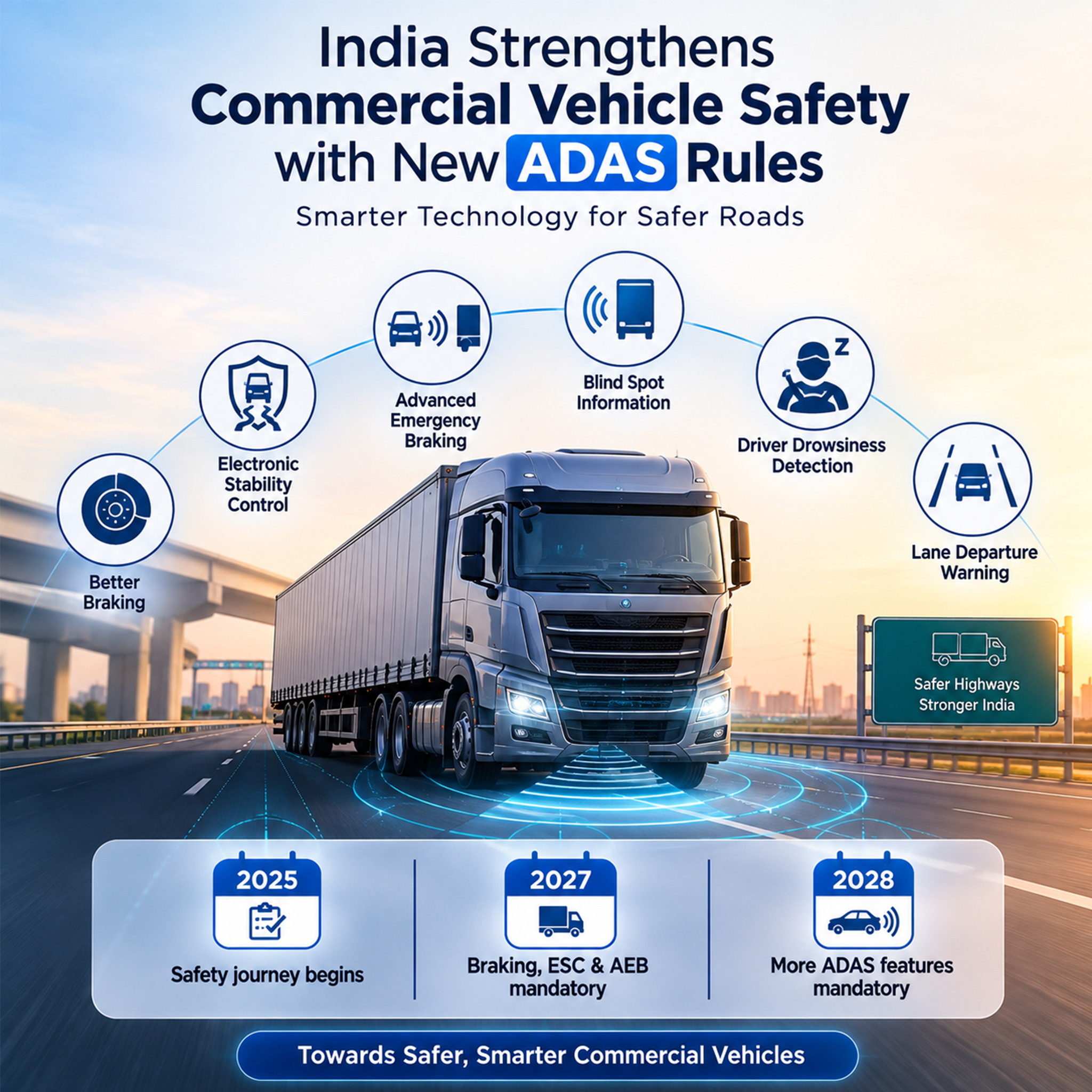
The Government of India has taken a number of steps to strengthen ADAS in Heavy Commercial Vehicles and to improve safety standards of medium and heavy-duty vehicles. The Ministry of Road Transport & Highways has announced mandatory requirements including braking performance, electronic stability control, emergency braking, blind spot information, driver drowsiness detection, lane departure warnings and other safety systems.
These requirements will be phased in, with key implementation dates beginning in 2025 and continuing through 2027 and 2028. But for vehicle manufacturers, exporters and businesses in the automotive sector, these developments mean a big change in India’s commercial vehicle safety framework.
A Different Way to Safety for Heavy Commercial Vehicles
Technology to Make Vehicles Safer
Harsh road conditions are imposed on heavy commercial vehicles. Their size, weight and operating behaviour may intensify the effect of sudden braking, loss of control, driver fatigue or reduced visibility.
Recent Government measures emphasise the use of advanced vehicle technologies which target some of these risks.
The requirements released include areas such as:
- Better stopping power
- Stability Control (Electronic)
- Advanced emergency brake
- Blind spot data
- Moving off info.
- Detection of driver fatigue
- Lane departure warning systems
These technologies are part of a broader drive to active vehicle safety.
Why Changes Matter for Manufacturers
The new demands affect more than the design of vehicles. They can affect product development, testing, technical documentation and compliance planning.
Therefore, manufacturers working in the Indian market need to pay more attention to changing CMVR Safety Requirements and the technical standards referred to by the Government.
Braking requirements for trucks new
Revised Braking Efficiency Standard
Braking performance is one of the most important elements of the safety of commercial vehicles.
The Government has made the revised braking standard IS 11852:2019 mandatory for trucks from 1 October 2027 vide GSR 834(E) dated 11 November 2025.
This standard was previously used for buses manufactured by Original Equipment Manufacturers.
“The revised requirement is an important step forward in the evaluation of braking performance of trucks.
Electronic Stability Control
The Government has also mandated Electronic Stability Control under AIS 162 for trucks from 1st October 2027.
Electronic stability control can help keep your car stable, especially if you need to brake while going around curves.
Stability is of special importance for heavy commercial vehicles due to their size, weight and operating conditions.
Advanced Emergency Braking System Member of the Commercial Vehicle Program
Emergency Situations – Automatic Assistance
AIS 162 will demand that the specified trucks have an Advanced Emergency Braking System from 1 October 2027.
The system is designed to automatically brake when the driver does not respond to an emergency situation.
The purpose is to:
- Help avoid a collision with the obstacles ahead
- Decrease the severity of a crash
- Provide additional assistance in an emergency situation.
The demand is a clear sign of the growing importance of active safety technology in commercial vehicles.
ADAS Features To Expand Starting 2028
Information on Blind Spot and Moving Off
Advanced Driver Assistance Systems will play a bigger role under the new safety framework.
The Government has announced the mandatory implementation of:
- Blind Spot Information System, under AIS 186
- Moving Off Information System, AIS 187
The requirements will be effective as of 1 January 2028.
Such systems are designed to enhance awareness around heavy vehicles and enhance safety for vulnerable road users.
Detection of Driver Drowsiness
Another major road safety problem is driver fatigue.
AIS 184 Driver Drowsiness Detection and Alert System will be mandatory from 1st January 2028.
The system is designed to eliminate problems that occur when the driver falls asleep, and the car starts to deviate from the intended path of movement.
The requirement places more emphasis on monitoring driver alertness as part of the overall vehicle safety system.
Lane Departure Warning
AIS 188 Lane Departure Warning System will also become mandatory from 1 January 2028.
The system warns the driver when a vehicle is not following the desired path of travel.
Together, these requirements point to the way in which India’s commercial vehicle safety framework is heading to technologies that can help drivers before trouble strikes.
Other Commercial Vehicle Safety Measures other than ADAS
Air Conditioning for Truck Cabins
Driver fatigue and comfort are also part of the Government’s wider approach to safety.
From October 1, 2025, air conditioning in the cabins of trucks will be mandatory under the Central Motor Vehicles Rules (CMVR).
The purpose of the measure is to reduce fatigue of the drivers when operating the vehicles.
Reverse Parking Warning Systems
Vehicles for the transport of goods, manufactured on or after 1 April 2020, other than puller tractors for trailers, must be equipped with a reverse parking alert system that conforms to AIS-145:2017.
This adds another layer of safety during vehicle manoeuvring.
Reflective Tape and Underrun Protections
The Government has also introduced safety standards on visibility and protection for goods vehicles.
AIS-090:2005 requires reflective tape to be applied across the width of the body of trucks.
They should also be equipped with:
- Rear under-run protection devices as per IS 14812
- IS 14862 Lateral under-run protection devices
These measures work in conjunction with the newer electronic safety technologies.
How the Changes Affect Automotive Businesses
Product Development and Compliance Needs
The development of mandated safety technologies could impact the approach of manufacturers to commercial vehicle development.
Businesses may need to consider the relationship between:
- Car design
- Safety technology
- Testing requirements
- Technical standards
- Compliance with regulations
The changes also suggest that vehicle safety is evolving beyond just fundamental mechanical systems.
Safety Certification Gaining in Importance
As safety requirements are becoming driven more and more by technology, certification and conformity assessment are becoming important elements of the automotive regulatory environment.
AIS Compliance is particularly relevant where applicable AIS requirements apply to vehicle systems and components.
At the same time, businesses must differentiate automotive standards from other regulatory systems, such as BIS Certification, applicable to products covered under the relevant BIS requirements.
Challenges in an Evolving Safety Environment
Addressing Several Technical Needs
Commercial vehicle manufacturers may face multiple requirements at the same time.
The use of different technologies at different points in time can complicate the regulatory planning process.
So manufacturers and suppliers may have to keep an eye on:
- Vehicle categories covered
- Applicable AIS requirements
- Dates of implementation:
- Expectations for test
- Technical documents
Managing Global Supply Chains
Many commercial vehicle manufacturers are sourcing from international suppliers.
Suppliers will need to adapt their products to the requirements of vehicles entering the Indian market as and when new safety technologies are mandated.
This can impact sourcing, product specifications, testing and documentation along the supply chain.
Why safety of heavy commercial vehicles is becoming a priority
The increasing focus on Heavy Commercial Vehicle Safety demonstrates the need to mitigate the risks associated with large vehicles on Indian roads.
Modern safety systems can provide further assistance in the following situations:
- Unexpected obstacles.
- Emergency brake
- Drowsy Driving
- Lane Departure Warning System
- Unseen areas
- Vehicle instability.
The Government’s phased approach also provides the industry with clear timelines for the launch of several technologies.
The Wider Implication for the Indian Auto Industry
The move to more sophisticated safety technologies can have impacts on the wider automotive ecosystem.
Manufacturers, component suppliers, testing organisations and technology providers may all see changes as new requirements come into effect.
Industry resources such as ERA Global Standards Certification can provide updates on automotive regulatory developments, with more information on certification and compliance developments.
The message is clear: commercial vehicle safety is becoming more and more dependent on advanced technology, standardised testing and regulatory compliance.
With an eye to 2027 and 2028
The announced implementation dates provide a clear timetable for a number of major safety requirements.
Trucks will get a refresh on braking rules, electronic stability control and Advanced Emergency Braking System requirements from October 1, 2027.
From 1 January 2028, other systems will be compulsory, including systems for blind spots, moving off information, driver drowsiness and lane departure.
All of these developments show a gradual evolution toward more sophisticated safety systems for heavy commercial vehicles.
For manufacturers and businesses, understanding this transition is emerging as an important part of long-term automotive planning.
Conclusion
India’s commercial vehicle safety ecosystem is entering a very important phase of development.
The latest Government measures include a combination of improved braking standards and electronic stability control, emergency braking, driver monitoring, awareness of blind spots, lane departure warnings and other safety requirements.
For manufacturers, exporters and businesses in the automotive sector, the changes highlight the growing importance of CMVR Safety Requirements, AIS standards and general regulatory compliance.
India’s approach is also trending toward more advanced safety technologies in heavy commercial vehicles with a phased implementation through 2027 and 2028.
About Author
ERA Global Standards Certification provides information on international product regulations, certification requirements, and market access developments in global industries. Contact us.