
India’s Electrical Industry Prepares for New Compliance Phase From Oct 2026
Introduction
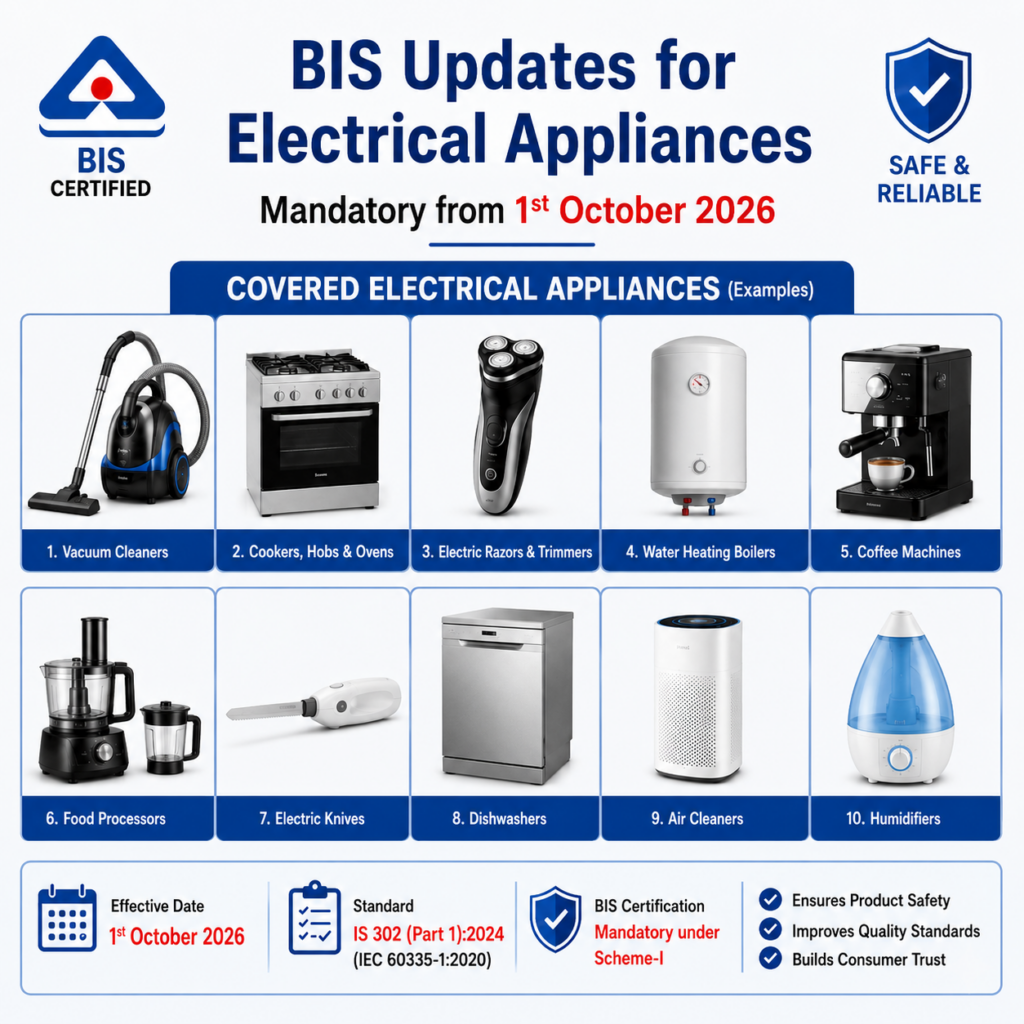
India’s electrical appliance industry braces for a major regulatory update. The BIS Updates via the Safety of Household, Commercial and Similar Electrical Appliances (Quality Control) Order, 2026 make BIS Certification mandatory in India for a wide variety of electrical appliances. The Order applies to electrical appliances for household, commercial or similar applications within the voltage limits specified from 1 October 2026. The products covered under the Order shall conform to IS 302 (Part 1):2024 / IEC 60335-1:2020 and shall bear the BIS Standard Mark under Scheme-I of the BIS (Conformity Assessment) Regulations, 2018.
This development is a reflection of India’s sustained focus on product safety, quality and standardisation for manufacturers, importers, exporters and business owners. With businesses keeping an eye on BIS Latest News, it will become more important to understand the scope and impact of this Order for future manufacturing and market planning.
A New Era Dawns for India’s Electrical Appliance Industry
What the New Quality Control Order Provides
The Ministry of Commerce and Industry’s Department for Promotion of Industry and Internal Trade (DPIIT) has issued the Safety of Household, Commercial and Similar Electrical Appliances (Quality Control) Order, 2026 under the Bureau of Indian Standards Act, 2016. The Order replaces the 2025 Order and specifies mandatory compliance requirements for the notified electrical appliances.
As per notification:
This Order is effective October 1, 2026.
Covered products shall comply with IS 302 (Part 1):2024 / IEC 60335-1:2020.
Products must carry the BIS Standard Mark under a valid BIS licence granted under Scheme-I.
This notification is another step in India’s continuous efforts for improving product quality and consumer safety in the electrical appliance sector.
Why This Regulatory Update Is Important to You
Electrical appliances are commonly found in homes, businesses, and workplaces. With advancements in technology and proliferation of product categories, it is even more important to maintain consistent safety standards.
The new Order provides a common regulatory framework for the notified products and at the same time, recognises the importance of standardised manufacturing practices across the industry.
The New BIS Requirements Coverage
What Electrical Products the Order Includes
This Order applies to electrical appliances intended for use with a rated voltage not exceeding 250 V for single-phase appliances and 480 V for other appliances, including direct current supplied and battery-operated appliances, intended for household, commercial or similar uses.
The notification is broad-based and covers just about all the major categories of household and commercial electrical appliances.
Some examples are:
Hoovers, Cookers, hobs and ovens, Electric razors and trimmers, Electric Water Heating Boilers, Coffee machines, Processing of food, Electric knives, Dishwashers, Commercial electric cooking appliances, Commercial dishwashers, Air-cleaning machine, Humidifiers, Vaporiser, Personal care appliances, Battery-powered vacuum cleaners, Battery-operated massage devices, Battery-operated air cleaner and more electrical appliances. In all, the notification covers 90 categories of electrical appliances under the prescribed Indian Standard.
Important Dates for Businesses to Implement
The notification lays down phased implementation dates for various categories of enterprises.
Effective Date for Common Manufacturers.
1 October 2026,
Small Businesses 1 Jan 2027,
Micro Enterprises 1 April 2027.
Importance of Product Certification in Today’s Global Market
Building consistency based on recognised standards
Product certification is now an integral part of modern-day manufacturing. In global markets, businesses are expected to produce products that comply with recognised technical and safety standards.
Support for certification: Consistency of product, Quality of manufacture, Technology reliability, Safety of consumer, Standardised manufacturing procedures. As industries evolve, established standards offer a foundation for confidence throughout the supply chain.
How Certification Aids International Trade
International trade is increasingly reliant on adherence to national regulations.
Products aligned to recognised standards are typically better placed for regulatory acceptance because they show alignment to defined technical requirements.
BIS Certification for Electrical Products is an integral part of India’s quality infrastructure, and the certification process enables more confidence among manufacturers, distributors and buyers in businesses manufacturing electrical appliances.
What this means for electrical product makers
Manufacturing practices are becoming more standardised.
It is anticipated that the new Order will encourage manufacturers to adhere to the stipulated Indian Standard for safety of electrical appliances during production.
This will put more weight on:
- Quality of product
- Manufacturing of uniforms
- Technical data
- Standardised production systems
- Quality management practices.
The mandatory quality requirements are being expanded all the time, and standardisation is becoming an increasingly important aspect of manufacturing operations.
Focus on product quality and documentation increased
The notification also emphasises the need to keep the product in conformity with the relevant Indian Standard.
The technical records usually kept by manufacturers include:
- Product specifications
- Design documentation
- Production data
- Quality assurance records
- Test Reports Where Appropriate.
Well-maintained documentation supports manufacturing consistency and helps businesses align with changing regulatory expectations.
Staying on Top of Regulatory Changes
India’s quality initiative is driving the continuous evolution of the electrical appliance industry. Companies usually keep track of new Quality Control Orders, amended Indian Standards and implementation schedules for various product groups through BIS Latest News and industry publications.
In addition, many manufacturers read technical articles about recent developments in related product sectors to better understand broader regulatory trends. Businesses are kept informed of evolving regulatory mandates by regular updates published on industry resources such as www.eraglobal.co.in covering certification and compliance.
Potential Impact on Importers of the New Requirements
Imported Products Compliance: What to Anticipate
The new Quality Control Order will also apply to importers importing electrical appliances into India.
The imported products covered under the scope of the notification shall comply with the relevant Indian Standard and shall bear the BIS Standard Mark under a valid licence before being introduced in the Indian market.
So importers may pay more attention to:
- Product Details
- Technical documentation
- Supplier files
- Indian Standards (IS)
- Planning of procurement.
As global supply chains change, regulatory compliance has become an important aspect of import planning and product management.
Improved Coordination Across the Supply Chain
Usually, importers use different manufacturers in different countries.
Mandatory quality requirements increase the level of coordination between manufacturers, suppliers, distributors and import partners. This helps in maintaining consistency during the product life cycle and supports compliance with applicable Indian Standards.
Business Benefits Above and Beyond Regulatory Compliance
Greater confidence in the market
Certification is no longer just a regulatory requirement. It also signifies the manufacturer’s adherence to recognised quality and safety standards.
Products conforming to established technical requirements often enable:
- More confident consumers
- Better Relationships with Distributors
- Improved product consistency
- Increased market credibility
- More confidence throughout the supply chain.
Product certification helps build confidence in a business over the long term, as industries continue to move toward recognised standards.
Promoting Sustainable Manufacturing Practices
Standardisation also encourages manufacturers to concentrate on consistency rather than variation.
This helps to:
- Improve manufacturing quality
- Enhance production control
- Technical uniformity requirements
- Product uniformity
- Quality improvement in the long term.
The increasing importance of BIS Certification for Electrical Products is a reflection of India’s ongoing commitment to enhancing manufacturing standards across all industrial sectors.
Why BIS Latest News Is Important For Electrical Business
Stay Current with Industry Trends
The ever-changing world of electrical appliances is a constantly evolving one, with new technologies, product innovations and safety expectations.
By regularly checking the BIS Latest News, businesses can see how changes in regulations might affect future manufacturing and product planning.
It also helps organisations keep track of:
- New Rules for Quality Control
- Updated technical specifications
- Product categories included in mandatory certification
- Timetables for Government Implementation.
A Changing Regulatory Landscape
A case in point is the Safety of Household, Commercial and Similar Electrical Appliances (Quality Control) Order, 2026, which shows India’s quality framework is improving.
For manufacturers, importers and exporters, staying abreast of regulatory developments assists in better planning and preparedness for future industry changes.
Also, many enterprises consider technical resources that talk about developments in certification across different industrial sectors, to get a broader view of India’s evolving compliance framework.
Within this broader regulatory ecosystem, organisations such as ERA Global Standards Certification are often referenced for providing information on certification requirements and market access developments.
October 2026 – Looking Forward
The introduction of the new Quality Control Order is yet another important milestone for the electrical manufacturing industry in India.
The notified electrical appliances will have to be compliant with IS 302 (Part 1):2024 / IEC 60335-1:2020 and bear the BIS Standard Mark under a valid BIS licence from 1 October 2026 onwards. Separate implementation dates have been specified for eligible small and micro enterprises.
The notification further says that the Bureau of Indian Standards will be the certifying and enforcement authority for the notified products with contravention penalties under the Bureau of Indian Standards Act, 2016.
As India’s manufacturing sector is growing, regulatory compliance is closely linked to product quality, consumer safety and standardisation of manufacturing practices.
Conclusion.
The Safety of Household, Commercial and Similar Electrical Appliances (Quality Control) Order, 2026 is a landmark regulatory development for the electrical appliance industry in India.
“From 1 October 2026, the notified household, commercial and similar electrical appliances shall conform with the relevant Indian Standard and obtain BIS Certification in India under Scheme-I before being placed on the Indian market. The Order also provides phased implementation dates for small and micro enterprises and specific exemptions for exports, research and development imports and eligible declared stock.
The new Order emphasises the increasing importance of quality, safety and regulatory compliance for manufacturers, importers, exporters and business owners operating in India’s electrical sector. Given the mandatory BIS Certification for Electrical Products for a wider range of appliances, it will remain important to keep abreast of BIS Latest News and BIS New Updates to understand future developments in the evolving quality framework in India.
About the author
ERA Global Standards Certification keeps you up-to-date on international product regulations, certification requirements and market access developments across global industries. For more information on certification and compliance updates, please visit www.eraglobal.co.in/contact.