
Manufacturing or Importing Hand Tools? Here’s What Changes from October 2026
Introduction
If you are a business that manufactures or imports hand tools, put October 2026 in your diary. The latest BIS Notification has made BIS Certification mandatory in India for specified hand tools as per the Hand Tools (Quality Control) Order, 2025. The notification states that the Order shall come into force with effect from 1st October, 2026 and the notified products should conform to the applicable Indian Standards and bear the BIS Standard Mark under Scheme-I of the BIS (Conformity Assessment) Regulations, 2018.
For manufacturers, importers, distributors and business owners, this development is a testimony to India’s continued thrust on product quality, standardisation and consumer safety. With the implementation date approaching, businesses will want to understand how these changes may impact manufacturing practices, sourcing decisions and overall business planning.
Understanding the Latest Notification of BIS
New Hand Tool Compliance Requirement
The Ministry of Commerce and Industry, through the Department for Promotion of Industry and Internal Trade (DPIIT), has notified the Hand Tools (Quality Control) Order, 2025 under the Bureau of Indian Standards Act, 2016. As per the notification, the specified hand tools shall conform to the relevant Indian Standards and shall bear the BIS Standard Mark under a valid BIS license. The Order comes into force on 1st October 2026.
This notification is a step in the continuing efforts of the Government of India to improve the quality of products in various manufacturing sectors through mandatory standardisation.
What does the notification mean
The notification sets out three major requirements for the hand tools being notified:
- Conformance to relevant Indian Standard.
- BIS Certification Scheme-I.
- Mandatory use of BIS Standard Mark before introducing the products in the Indian market.
These requirements are applicable to the products listed in the notification.
Why October 2026 is a moment of change
Mandatory Compliance Starts
The notified hand tools shall comply with the relevant Indian Standards except for the implementation timelines for small and micro enterprises, from 1 October 2026. The notification separately mentions 1 January 2027 and 1 April 2027 as implementation dates for small enterprises and micro enterprises, respectively.
This staggered introduction will allow different types of business to comply with the new regulatory framework.
Greater Emphasis on Product Standardisation
The notification also indicates a larger trend in the manufacturing sector in India.
In recent years, a growing number of industrial products have been subjected to mandatory quality requirements. This growing building block now includes hand tools, reaffirming the government’s continued focus on standardised manufacturing and product quality.
Covered Hand Tools under Quality Control Order
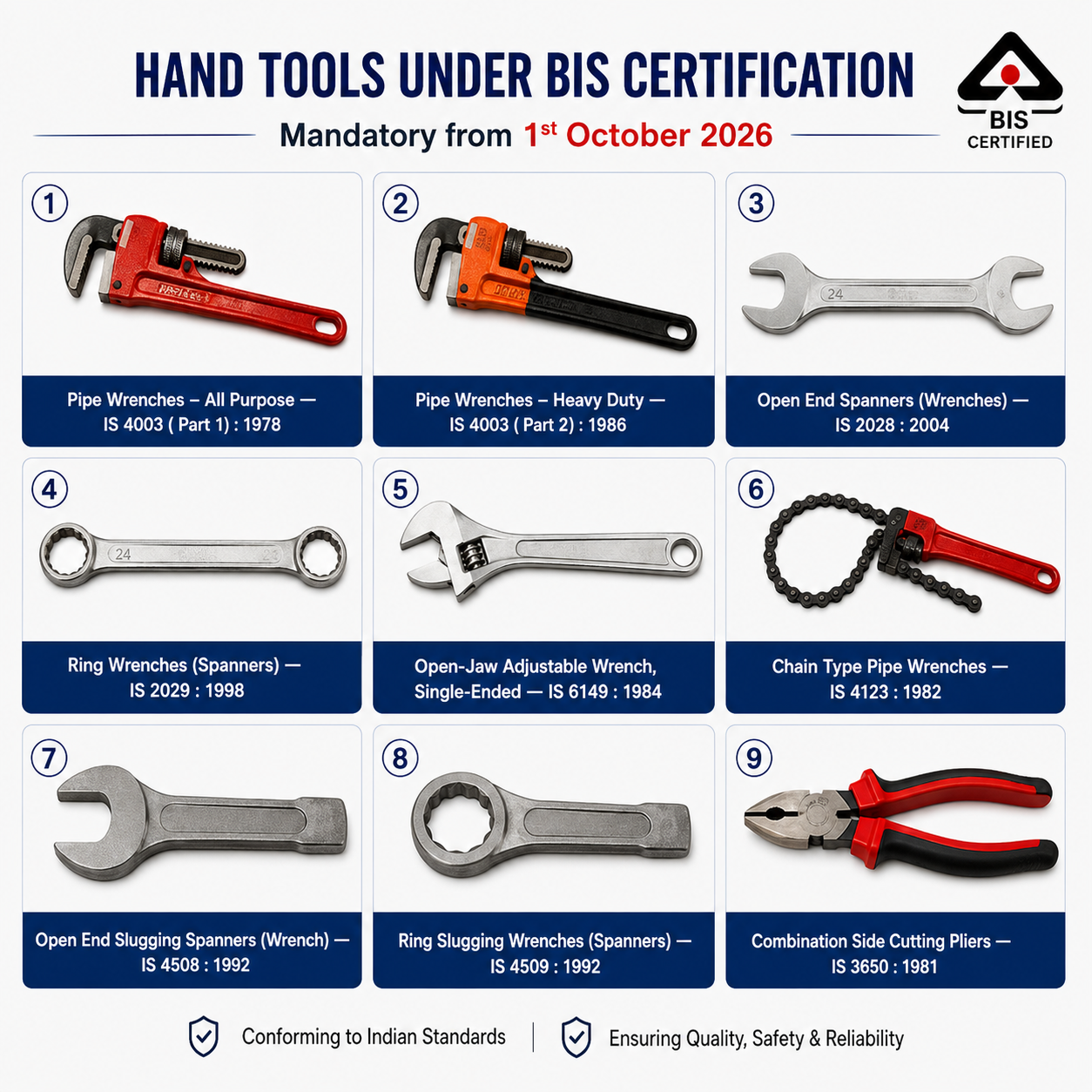
The notification includes the following hand tools and their relevant Indian Standards:
Manual Tools
Indian Standards, as applicable
- Pipe Wrenches – All Purpose — IS 4003 ( Part 1) : 1978
- Pipe Wrenches – Heavy Duty — IS 4003 (Part 2):1986
- Open End Spanners (Wrenches) — IS 2028:2004
- Ring Wrenches (Spanners) — IS 2029: 1998
- Open-Jaw Adjustable Wrench, Single-Ended — IS 6149 (1984)
- Chain Type Pipe Wrenches — IS 4123: 1982
- Open End Slugging Spanners (Wrench) — IS 4508: 1992
- Ring Slugging Wrenches (Spanners) — IS 4509:1992
- Combination Side Cutting Pliers — IS 3650:1981
The notification further states that the latest versions of these Indian Standards, including amendments notified by BIS from time to time, shall be applicable.
Importance of Product Certification in Global Trade
Certification Helps Quality Reliability
Product certification is now an important part of manufacturing worldwide. It offers confidence that products are made in compliance with recognised technical requirements and quality standards.
Business certification assistance:
- Consistent production processes
- Ensuring product quality
- Better Regulatory Alignment
- Increased confidence among buyers
- Standardised production methods
As international trade grows, certification is becoming an important part of business credibility.
The Importance of Standardisation
Today, manufacturing is all about consistency.
Standardised products build confidence throughout the supply chain as buyers know that they are getting products manufactured in accordance with recognised specifications.
This approach will encourage better manufacturing practices and will also support long-term quality improvements across industries.
Potential impact of the Notification on manufacturers
More Focus on Quality of Products
The Order shall implement a more structured regulatory framework for manufacturers producing the notified hand tools, once it comes into effect.
The notification stipulates that products should comply with the specified Indian Standards before they are allowed to carry the BIS Standard Mark.
Manufacturers may therefore pay more attention to:
- Consistency in manufacturing
- Product specification
- Technical Docs
- Quality Management Systems (QMS)
- Standardised methods of production
These factors already play an important role in modern manufacturing and are expected to become even more important with the increasing mandatory quality requirements.
Align Better with Industry Standards
The notice also calls on manufacturers to make their production practices consistent with national standards that are recognised.
This helps to ensure greater consistency across the industry, as well as supporting product quality and reliability.
BIS Certification: What Should Importers Know?
Compliance is more than just domestic manufacturing
The Quality Control Order is equally applicable to importers importing notified hand tools into India.
The products covered under the notification are anticipated to be in compliance with the relevant Indian Standards before entering the Indian market.
This implies that importers may give more attention to:
- Product specs
- Supplier docs
- Indian Standards applicable
- Records of Product Quality
- Procurement planing
As compliance expectations change, regulatory readiness, as well as commercial considerations, may play an increasingly important role in supplier selection.
Exemptions stated in the notification
The Order also allows for certain exemptions.
The notification says:
- It does not include goods made in the United States for export.
- It does not apply either to up to 200 imported hand tools per year brought in by manufacturers for research and development purposes only, provided that the tools are not sold commercially, and prescribed records are maintained.
These exemptions are specifically mentioned in the official notification.
Tracking Regulatory Developments
Regulatory notifications are becoming an important aspect of manufacturing and import planning as India’s quality framework continues to evolve.
Many businesses regularly monitor developments in product standards, quality control orders and industry developments in order to better understand changing compliance requirements. They also refer to technical articles on similar BIS developments in other industrial sectors to keep abreast of the wider regulatory landscape.
Impact on Trust in Brand and Market
Certification Increases Market Confidence
Product quality has become more important in purchase decisions across all industrial sectors. Standards are increasingly what buyers, distributors and purchasing teams look for in products.
Certification is a way of demonstrating that the products are manufactured in accordance with the set technical requirements. This helps foster greater confidence across the supply chain and supports consistent quality expectations.
Compliance also shows a commitment to standardised manufacturing practices for manufacturers and importers.
Supporting Long-Term Business Relationships
Consistency and dependability are the foundation of business relationships.
Products made in accordance with recognised standards can often contribute to:
- Increased Buyer Confidence
- Strong distributor relationships
- Uniform product quality
- Increased market credibility
- Improved business continuity
As industries move to higher benchmarks of quality, certification plays an important role in sustaining confidence in business in the long term.
Typical Challenges Companies Encounter
Applicable Standards
One of the first things businesses often look at is whether their products are in scope of the notification.
This generally means understanding:
- Relevant Indian Standards
- Product details Specifications
- Extent of the Quality Control Order
- Manufacture requirements
In analysing these aspects, businesses can gain insight into how the notification pertains to their products.
Technical Documentation Management
The certification of products is closely related to technical documentation.
For example, manufacturers normally keep records such as:
- Data on the product
- Drawings for engineering
- Manufacturing history
- Quality control documents
- Standard references
Good documentation helps to ensure consistency in the manufacturing process.
Production Planning and Supply Chain
Mandatory quality requirements also have an impact on production planning.
Businesses might look at:
- Manufacturing Schedule
- Purchasing planning
- Inventory control
- Coordination of Suppliers
- Distribution schedules
Such factors help in smoother running of the business as regulatory requirements are evolving.
Business Impact More than Compliance
Standardisation Fuels Manufacturing Growth
It’s more than just a regulatory development: the Hand Tools (Quality Control) Order, 2025. It reflects India’s ongoing focus on improving the quality of manufacturing through standardisation of products and recognised technical standards.
As more industrial products come under the quality control measures, business organisations are giving more weightage to:
- Consistent product
- Production quality
- Technical correctness
- Standardised production systems
- Ongoing quality improvement
These developments contribute to building a stronger manufacturing ecosystem and supporting long-term industrial growth.
Increasing Significance of Regulatory Awareness
Manufacturing regulations are still evolving in various product areas.
It is important for businesses to stay updated with the latest BIS notifications in order to know the changing quality requirements and industry developments.
Many organisations also refer to technical resources on recent BIS developments in various industries to better understand the overall direction of India’s quality framework. Industry platforms like ERA Global Standards Certification regularly publish updates and articles on certification-related developments, keeping businesses informed of changing regulatory requirements.
In this wider compliance context, companies like Era Global Standards Certification are often cited for sharing information on certification evolution and market access trends.
October 2026 Looking Forward to
India’s bid to raise product quality through standardisation received another boost with the implementation of the Hand Tools (Quality Control) Order, 2025.
For the notified hand tools, compliance with the relevant Indian Standards and BIS certification will be mandatory from 1 October 2026, although the notification states later implementation dates for eligible small and micro enterprises.
As the implementation date nears, manufacturers and importers are likely to focus more on product quality, manufacturing uniformity and alignment with regulations.
The notification also mentions that India’s quality infrastructure continues to expand across industrial sectors.
Conclusion
The Hand Tools (Quality Control) Order, 2025 is a significant regulatory change for the Indian hand tools industry.
The notified hand tools shall conform to the relevant Indian Standards and shall bear the BIS Standard Mark under a valid BIS licence, before being imported or placed on the Indian market, with effect from 1 October 2026. The notification also includes phased implementation dates for eligible small and micro enterprises, and limited exemptions for exports and for imports for research and development.
This development is a sign of India’s continued focus on product quality, standardisation and consumer safety for manufacturers, importers, distributors and business owners.
As manufacturing standards change all the time, being aware of regulatory changes helps companies know better what the industry expects and helps them maintain the same quality throughout their operations.
Author’s Bio
ERA Global Standards Certification offers insights on international product regulations, certification requirements and market access developments in global industries. For expert technical assistance on BIS Certification and regulatory compliance services, visit www.eraglobal.co.in/contact.