
Korea Revises KC Safety Guidelines for Large-Screen Smartphones
South Korea has one of the world’s most regulated electronics markets. Manufacturers and exporters must follow a wide range of rules and regulations. A small change in product classification can impact certification timelines, testing requirements and market entry strategies. That’s exactly why the latest update from the Korean Agency for Technology and Standards (KATS) is worth a look.
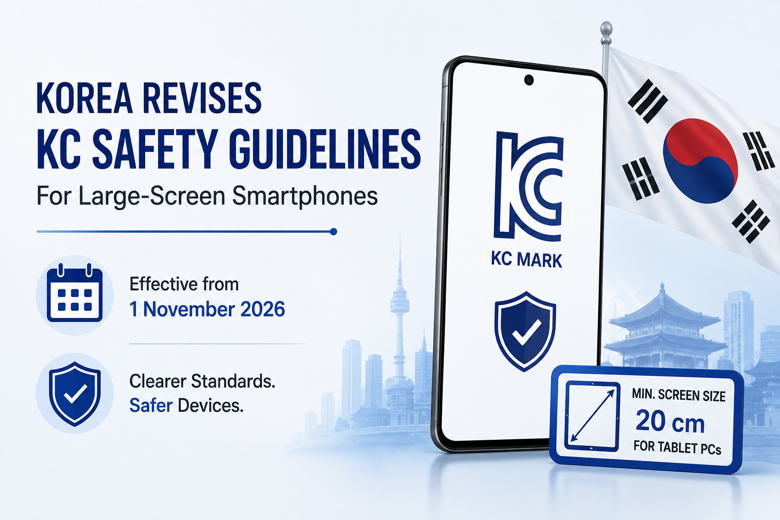
South Korea has revised its KC Safety Confirmation criteria for Tablet PCs, with the minimum screen diagonal size being raised from 17 cm to 20 cm, effective 1 November 2026. Therefore, many large-screen smartphones that had been classified as Tablet PCs under KC (Korea Certification) will now be covered by the Supplier’s Declaration of Conformity (SDoC) framework for smartphones. The amendment aims to clarify product classification. It also ensures more consistent regulations for manufacturers, importers and exporters entering the Korean market. KATS Notice No. 2026-191: Amended operational guidelines will come into effect on 1 November 2026.
Why this regulatory update is important
Over the last 10 years, the smartphone industry has changed rapidly. High-end smartphones now have screens as big as small tablets. As screen sizes are growing continuously, some flagship smartphones have crossed the earlier 17 cm barrier that was considered for Tablet PC classification.
This posed an unexpected regulatory challenge.
These products were sold and used as smartphones, but for the purposes of KC Safety Confirmation, they can be categorised as Tablet PCs, which will require a different compliance path to enter the Korean market.
KATS revised the operational guidelines to support the effective operation of Korea’s electrical appliance safety management system, recognising this issue and making a clearer distinction between smartphones and Tablet PCs. The amendment introduces specific changes to the Tablet PC classification criteria in Appendix 2. It also revises the self-inspection test items for primary batteries in Appendix 19.
Understanding KC (Korea Certification) Mark in Korea
It is helpful to understand how Korea regulates electrical and electronic products before looking at the amendment.
Electrical Appliances and Consumer Products Safety Control Act designates some safety management categories for electrical products sold in South Korea. The Operational Guidelines further specify the products covered by: Safety Certifications, KC Safety Validation, Declaration of Conformity (DoC) from the supplier, and Safety Examination.
The guidelines also specify the detailed product categories in the relevant appendices to ensure manufacturers, importers and exporters are aware of the compliance framework applicable to each product.
Choosing the right product classification is key for Korea Electronics Compliance, as the procedures for the conformity assessment will vary based on the regulatory category.
What’s New About the New KC Safety Rules?
The latest amendment relates to the classification of Tablet PCs in Appendix 2 of the Operational Guidelines.
Prior Requirement
Old criteria:
Devices with a screen diagonal of 17 cm or greater could be classified as Tablet PCs.
So some large-screen smartphones fell under the scope of KC Safety Confirmation although they were conceived and marketed as smartphones in the first place.
This created compliance uncertainty for manufacturers introducing premium smartphones in the Korean market.
Updated Requirement:
KATS has raised the minimum Tablet PC screen size to 20 cm from 1 November 2026.
Under the changed definition:
Tablets are devices with a screen diagonal of at least 20 cm.
The screen size no longer automatically makes a device a Tablet PC if it is under 20cm.
Tablet PCs that support voice-calling features continue to be classified as Tablet PCs if they meet the new screen-size requirements.
This amendment provides a better distinction for Korea Certification for Smartphones and related compliance obligations for Smartphones and Tablet PCs.
Effect on Korea Mobile Certification
For smartphone makers selling their products in South Korea, the amendment is more than a technical tweak.
This enhances regulatory certainty when determining whether a product falls under the KC Safety Confirmation or the Supplier’s Declaration of Conformity (SDoC) regime.
Some flagship smartphones that used to be over 17 cm may now fall under the smartphone compliance framework rather than the Tablet PC category, if they don’t meet the revised 20 cm criterion.
The revised classification reduces ambiguity for companies involved in Korea Smartphone Certification, both in terms of product planning, regulatory review and market entry.
Implications for Manufacturers and Exporters
The new rule has implications for a wide range of actors in the electronics supply chain.
Phone Makers
Manufacturers launching new smartphones in South Korea should consider how the revised classification will affect their future product portfolios, especially in light of the trend of increasing display sizes.
Importers
Before placing products on the Korean market, importers should understand the impact of product classification on applicable conformity assessment requirements.
Exporters
Companies exporting consumer electronics products to Korea should watch out for changes to regulatory definitions. Similar products may fall under different compliance categories depending on their technical specifications.
Testing Labs
Testing organisations should coordinate product evaluations with the amended classification criteria upon the amendment’s entry into force.
Compliance Consultants
Companies that support Korea Electronics Compliance should watch how manufacturers classify future smartphone and Tablet PC models under the new Operational Guidelines.
Transitional Measures Ease Regulatory Disruption
KATS has made the amendment with transitional provisions to avoid unnecessary compliance burden.
The amended Operational Guidelines also provide transitional provisions. Products that completed KC Safety Confirmation, safety inspection, or received an exemption before the amendment may be treated as meeting the revised Supplier’s Declaration of Conformity requirements, where applicable.
In addition, the transitional arrangements apply to products for which applications are pending before the enforcement date. These provisions help to ensure business continuity as they move through the regulatory process.
Product classification is more important than ever now.
The reality is that in today’s electronics industry, innovation is often faster than regulations.
Larger displays and foldable devices are becoming increasingly common. Hybrid communication products also blur the traditional distinction between smartphones and Tablet PCs.
The updated KC (Korea Certification) rules are an effort to update the classification of products while maintaining the goals of product safety. As product specifications continue to change, it is increasingly important for manufacturers, exporters and importers to be aware of these changes.
Organisations tracking global product regulations should monitor these updates closely. This is especially important for evolving Korea Smartphone Certification requirements.
Businesses can also review information on Korea Certification for Smartphones and related compliance requirements. ERA Global Standards Certification. provides information on these regulatory developments.
Manufacturers often build product families with different screen sizes. These products may have similar hardware and software configurations. A minor modification to the size of the display could now determine whether a product falls under the KC Safety Confirmation or Supplier’s Declaration of Conformity (SDoC) system.
Global brands often sell similar devices across different regions. Therefore, accurate product classification is becoming increasingly important. The internal documentation, technical specifications and compliance records should be in line with the applicable Korean regulatory requirements.
Suppliers, distributors and retailers will also need to understand how future product launches will be classified under the revised criteria to prevent confusion throughout the supply chain.
Why this amendment matters for Korean electronics compliance
South Korea frequently updates its product safety regulations to keep pace with technological advancements and to achieve better regulatory clarity.
The newest amendment shows how regulators are modifying existing compliance frameworks to accommodate the changing landscape of modern consumer electronics. The amended criteria clarify the distinction between smartphones and Tablet PCs, rather than broadening the scope of regulatory requirements, in relation to updated technical parameters.
The regulatory updates serve as a reminder to companies that are involved in Korea Electronics Compliance to pay attention to official notifications and to assess how the evolving design of their products meets current classification requirements.
The amendment also underlines the importance of accurate product definitions to ensure that manufacturers and importers carry out the relevant conformity assessment procedures before products are placed on the Korean market.
Key Takeaways
The revised operational guidelines introduce a significant change for manufacturers, exporters and importers of smartphones and Tablet PCs.
Key highlights:
The minimum screen diagonal for Tablet PC classification is increased from 17 cm to 20 cm.
KC Safety Confirmation still classifies devices with a display size of 20cm or larger as Tablet PCs.
Applicable compliance framework for smartphones applies to devices with a screen size less than 20cm.
Interim measures protect existing certifications and pending applications until the new rules come into force.
KATS Notice No. 2026-191 states that the amendment shall enter into force on 1 November 2026.
Looking Forward
The consumer electronics industry is still evolving with larger displays, foldable devices, hybrid communication products and multifunction portable electronics. As technology advances, so too must regulatory structures to ensure effective product safety oversight and to provide greater clarity for businesses.
This approach is also reflected in the revised Korea Certification requirements, updating product classification criteria with no change to the overall objective of consumer safety protection.
Keeping pace with regulatory amendments remains an important part of long-term market planning for manufacturers looking forward to future product launches, exporters looking to expand into South Korea and importers looking to introduce new electronic devices.
Summary
South Korea’s recent amendment to the KC (Korea Certification) framework shows the country’s ambition to align product safety regulations with the evolving consumer electronics market. KATS has further differentiated smartphones and Tablet PCs by raising the minimum screen diagonal for Tablet PC classification from 17cm to 20 cm, which will reduce classification ambiguity for manufacturers, importers and exporters. The amendment also includes transitional provisions to avoid undue regulatory disruption to the continuity of existing certifications and active applications.
About the Author
ERA Global Standards Certification delivers industry news and regulatory intelligence on global product compliance, so manufacturers, exporters and importers can keep pace with changing certification requirements for international markets. If you want to know more about certification updates and compliance requirements, check out www.eraglobal.co.in/contact.Businesses can also review information on Korea Certification for Smartphones and related compliance requirements.