
SNI Certification for Safety Glass in Indonesia: New Mandatory Requirements for Buildings and Panels
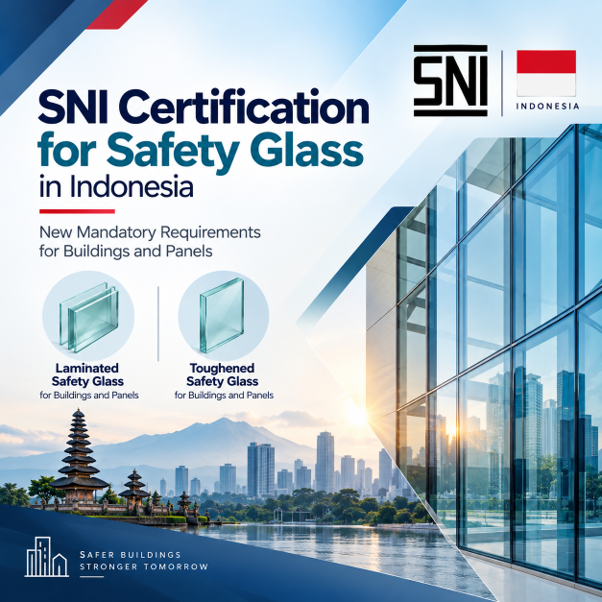
A safety glass product can meet strong quality standards in one country and still face market-access barriers in another. That is becoming more important for manufacturers and exporters targeting Indonesia. Under SNI Certification for Safety Glass in Indonesia, the Indonesian Ministry of Industry has introduced mandatory national standards for safety glass used in buildings and panels. The regulation covers both locally produced and imported products intended for circulation or sale in Indonesia. It also sets requirements for certification, production controls, product testing, marking, and imported-product handling. For businesses in the glass sector, this is more than a technical requirement. It can influence market access, documentation, supply arrangements, and customer confidence. all focus keyword
SNI certification for safety glass in Indonesia — What Has Changed?
The new regulation makes SNI compliance mandatory for covered building and panel safety glass. It applies to businesses that manufacture, import, and distribute the specified products in Indonesia.
The regulation covers two main product groups:
Laminated safety glass for buildings and panels
Toughened safety glass for buildings and panels
For laminated safety glass, the regulation refers to classifications including LA, LD, LHS, LM, LP, LR, LT, and LX. Toughened safety glass includes sheet, patterned, decorative, and reflective types. Specific HS tariff classifications are also identified.
Some products are excluded where they have different technical characteristics and fall under separate standards. Testing samples used for SNI certification are also excluded under the stated conditions. Research and development samples can qualify for exclusion up to 10 sheets, but they cannot be sold, transferred, or used for market testing.
SNI 9144-1:2022 and SNI 9144-2:2022 Set the Technical Basis
The regulation identifies two key standards for the covered products.
SNI 9144-1:2022 applies to laminated safety glass for buildings and panels. SNI 9144-2:2022 applies to toughened safety glass for buildings and panels. These standards provide the technical basis for the compulsory SNI framework.
The certification uses a Type 5 conformity assessment system. It includes production process audits, an ISO 9001:2015 quality management system audit, and product conformity testing. Therefore, certification is linked to both manufacturing controls and product performance.
Other Certifications and Quality Requirements
SNI certification does not stand alone. ISO 9001:2015 is part of the certification framework, making quality management an important part of compliance.
The regulation also refers to SNI-certified glass raw materials, including:
SNI 47:2018
SNI 4756:2021
SNI ISO 25537:2011
SNI 1773:2019
SNI 9237:2023
Manufacturers must also have suitable production facilities and testing equipment for the relevant type of safety glass.
SNI Mark Indonesia and Product Identification
Meeting the applicable standard is only one part of the regulatory framework. Products that meet SNI requirements and are intended to carry the SNI mark must have approval for its use. This approval is issued as an SPPT SNI.
The certificate also provides important product information. For imported safety glass, this includes the producer’s details, factory address, brand, product information, SNI number and title, certificate date, validity period, the name and address of the Perwakilan Resmi, and the warehouse address.
This makes accurate product identification important for manufacturers and businesses involved in distribution.
SNI certification for safety glass in Indonesia and Imported Products
The regulation has particular importance for international manufacturers and exporters. A producer outside Indonesia must meet the specified requirements before its covered safety glass can enter the Indonesian market.
A Specific Warehouse Requirement for Imported Safety Glass
One important requirement concerns the handling of imported products.
Safety glass manufactured outside Indonesia must be placed in a warehouse controlled by the Perwakilan Resmi before it is circulated or transferred. The entry of these products is subject to verification or technical tracing. This check confirms that the delivery address stated in the import documents matches the warehouse address controlled by the Perwakilan Resmi.
This requirement adds an important physical and documentary element to the import compliance framework. It also means that import arrangements and warehouse information can become relevant to regulatory compliance.
Importance of Product Certification in Global Trade
Product certification has become an important part of international trade. A product may be technically sound, but destination-market rules still determine whether it can be placed on that market.
For example, businesses following the Latest BIS Notification in India must consider that Indonesian requirements may be different. Likewise, Aluminium Product Certification in the Philippines operates under a separate national regulatory framework.
These Differences Matter: Key Considerations Under the BIS CRS Update 2026 for Smart Glasses
Product standards
Testing requirements
Certification systems
Marking rules
Import conditions
Market surveillance measures
Therefore, exporters cannot assume that compliance in one country automatically satisfies another country’s requirements.
Impact of the BIS on Brand Trust and Business Compliance
Certification also has a commercial dimension. Buyers, contractors, and project stakeholders often need confidence that safety-related products meet the applicable requirements.
For glass used in buildings and panels, this confidence can be particularly important because product performance is closely connected with safety.
Clear certification records can also support traceability. A consistent link between the manufacturer, factory, brand, product specifications, certificate, and marking can reduce uncertainty during commercial transactions.
For businesses reviewing regulatory developments, industry certification information can also provide useful context when comparing requirements across different markets.
Common Challenges for Manufacturers and Exporters
The new framework can create practical challenges, especially for companies with several production locations or product categories.
Key areas of concern include:
Production and Testing Capacity
The regulation specifies different production facilities and testing equipment for laminated and toughened safety glass. This can make internal manufacturing controls more detailed.
Documentation
Businesses must maintain product, quality, production, brand, and certification information. Imported products also involve additional information concerning the Perwakilan Resmi and warehouse.
Ongoing Compliance
The SNI Certificate is valid for five years and applies to one production location. More than one brand can be included in a certificate under the specified conditions.
What Businesses Should Watch
The regulation provides a transition period before mandatory SNI implementation takes effect. The compulsory requirement applies six months after the regulation comes into force. Certain products and existing certificates also receive transitional treatment under specified conditions.
For manufacturers, exporters, importers, and distributors, the change signals a stronger focus on documented conformity in Indonesia’s safety glass market.
Conclusion
Indonesia’s new safety glass regulation brings product standards, manufacturing controls, quality management, testing, marking, and import arrangements into one compulsory framework. The requirements apply to both domestic and imported safety glass covered by the regulation.
For businesses operating internationally, the development also highlights a broader reality: market access increasingly depends on understanding the specific compliance framework of each destination. As Indonesia strengthens its requirements for building and panel safety glass, certification will remain an important consideration for trade, product credibility, and long-term business relationships.
ERA Global Standards Certification provides regulatory insights for businesses navigating product regulations, certification requirements, and international market access. Learn more at www.eraglobal.co.in/contact.