
Which Bearing Components Are Covered Under the Complete Essential Critical Mandatory Draft QCO 2025 BIS Certification Rules?
The bearing industry in India is likely to witness a major shift in compliance with the draft Bearing Components and Accessories (Quality Control) Order, 2025. The Government of India has filed a notification that aims to bring a host of critical bearing products under mandatory BIS compliance requirements. This is a step towards improving quality standards across industrial and engineering sectors.
The latest BIS updates for the bearing industry have caught the attention of manufacturers, importers, OEM suppliers, and engineering companies, as the proposed regulations could impact production, imports, and product approvals in India. Under the draft Bearing QCO 2025, many bearing components and accessories may soon require mandatory BIS licenses to be sold in the Indian market.
Department for Promotion of Industry and Internal Trade (DPIIT) has proposed a Quality Control Order for bearings in consultation with the Bureau of Indian Standards (BIS). The notice has been issued to improve product quality, industrial safety, reliability, and standardisation in the bearing manufacturing ecosystem.
Why the Government Is Focusing on Bearing Components
Bearings are one of the important mechanical products used in industrial and automotive systems. They are found in electric motors, pumps, railway equipment, manufacturing plants, heavy machinery, construction equipment, automotive assemblies, and industrial rotating systems. Machinery failure, production stops, higher maintenance costs, and risks to operational safety can arise from minor defects in bearing components.
The Government is also working towards eliminating the circulation of low-quality products through mandatory BIS certification for bearings and enhancing consistency in manufacturing standards. The proposed regulation is likely to promote orderly manufacturing practices and raise trust in certified products across the Indian market.
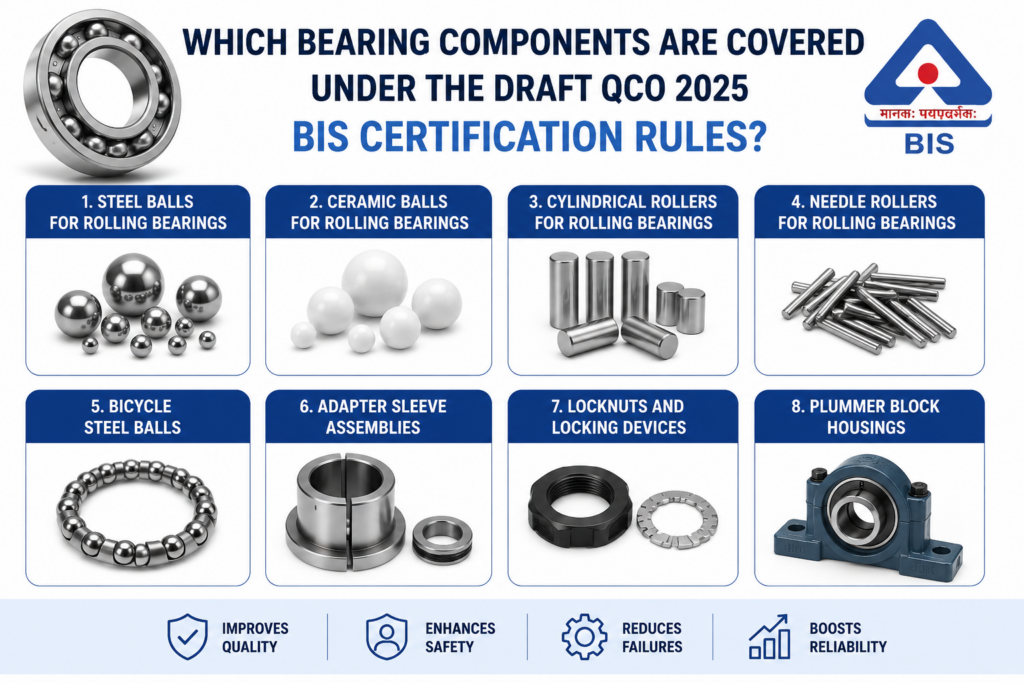
Bearing Components and Accessories Proposed Under the Draft QCO
The draft notification includes several categories of bearing components and accessories that may soon come under compulsory BIS certification requirements.
Steel Balls for Rolling Bearings
One of the major product categories included in the draft notification is steel balls used in rolling bearing systems. The proposed standards for Steel balls for rolling bearings BIS compliance fall under IS 2898 (Part 1):2019 / ISO 3290-1:2014. These components are essential for reducing friction and enabling smooth rotational movement in industrial machinery and automotive systems. Since steel balls directly affect bearing efficiency and durability, the Government’s move toward mandatory certification is expected to improve dimensional precision, hardness consistency, and operational performance.
Ceramic Balls
The notification also covers ceramic balls for use in advanced industrial applications. The proposed Ceramic balls BIS certification under IS 2898 (Part 2):2019 / ISO 3290-2:2014 is of critical importance for industries using high-speed and high-temperature bearing systems. Ceramic balls are widely used in precision engineering, aerospace, electric vehicles and medical equipment due to their lightweight structure and corrosion resistance. Critical applications could be better served and more reliably served with mandatory BIS compliance.
Cylindrical Rollers
Another important category proposed in the draft Bearing QCO is cylindrical rollers used in rolling bearing systems. The impact of the proposed Cylindrical rollers BIS requirements under IS 9202:2020 is likely to be felt in industries where heavy radial load machinery such as rolling mills, gearboxes, industrial motors and power transmission systems are used. Given the importance of cylindrical rollers in load distribution and operational efficiency, quality standardisation would likely improve industrial performance and reduce mechanical failures.
Needle Rollers
The latest Bearing industry BIS updates also include needle rollers for compact bearing assemblies. The Needle rollers certification India requirements under IS 4217:2020 are expected to impact automotive transmission systems, compressors, industrial tools and mechanical equipment manufacturers. Needle rollers work under demanding conditions and therefore need high-precision manufacturing. BIS certification may enhance product reliability, load-handling capabilities and durability for industrial uses.
Bicycle Steel Balls
The draft notification also includes bicycle steel balls, in addition to industrial bearing products. The suggested Bicycle balls BIS approval under IS 15184:2002 is reflective of the Government’s broader perspective towards quality standardisation for diverse categories of products. Bicycle balls are relatively small parts, but they are important for the movement of the wheel, stability, and overall riding performance.
Adapter Sleeves and Withdrawal Sleeves
The draft notification also includes accessories for mounting and installation of bearings, such as adapter sleeves and withdrawal sleeves. The proposed Adapter sleeve assemblies BIS requirements under IS 16605 (Part 1):2018 / ISO 2982-1:2013 are likely to improve installation accuracy and operational safety of industrial systems. They are widely used in engineering applications and machinery maintenance for mounting and dismounting bearings.
Locknuts and Locking Devices
Locknuts and locking devices are also an important category under the proposed Quality Control Order for bearings. The BIS requirements for Locknuts and locking devices under IS 16605 (Part 2):2018 / ISO 2982-2:2013 aim to enhance the stability and safety of rotating machinery systems. Locking devices are used to prevent the loosening of the bearing during the operation of the machine. They are widely used in motors, industrial equipment, and automotive systems.
Plummer Block Housings
The notification also proposes mandatory compliance requirements for the plummer block housings BIS. Industries such as mining, conveyor systems, cement manufacturing, steel plants and heavy engineering sectors are likely to be impacted by the proposed Plummer block housings BIS requirements under IS 14347:1996. These housings house bearings and rotating shafts, and are essential for alignment, durability and operational stability in industrial machinery.
BIS Certification Requirements Under the Draft Bearing QCO
The proposed regulations would make it mandatory for manufacturers and importers dealing in covered products to obtain BIS certification for bearing components before selling products in India. The products shall conform to the relevant Indian Standards and shall carry the BIS Standard Mark under a valid BIS licence.
The certification process is expected to comprise product testing, factory inspection, review of technical documentation and ongoing monitoring of compliance. The proposed rules would apply to domestic manufacturers as well as foreign manufacturers exporting products to India.
Proposed Timeline for Industry Compliance
The draft notification provides timelines for the phased implementation of the different categories of enterprises. General manufacturers may be given six months from the date of publication of the final notification for compliance, and small enterprises and micro enterprises may be given additional time for implementation.
This staged approach can help companies prepare in a stepwise fashion for the testing, documentation, certification processes and manufacturing upgrades required under the new compliance framework.
Impact on Manufacturers and Importers
Bearings are one of the important mechanical products used in industrial and automotive systems. They are found in electric motors, pumps, railway equipment, manufacturing plants, heavy machinery, construction equipment, automotive assemblies, and industrial rotating systems. Machinery failure, production stops, higher maintenance costs and risks to operational safety can arise from minor defects in bearing components.
The Government is also working towards eliminating the circulation of low-quality products through mandatory BIS certification for bearings and enhancing consistency in manufacturing standards. The proposed regulation is likely to promote orderly manufacturing practices and raise trust in certified products across the Indian market.
Conclusion
The draft Bearing Components and Accessories (Quality Control) Order, 2025, is a significant regulatory step in India’s industrial manufacturing and engineering sector. The Government wants to improve the product quality, safety, reliability, and standardisation of the bearing industry through mandatory BIS certification for bearing components.
BIS compliance might soon be mandatory for steel balls, ceramic balls, cylindrical rollers, needle rollers, bicycle balls, adapter sleeve assemblies, locknuts and locking devices, and Plummer block housings. With the new BIS updates for the Bearing industry still in the making, manufacturers and importers should watch developments around the proposed Bearing QCO 2025 and prepare early for compliance to ensure smooth access to the Indian market.
Author Bio
Era Global Standards Certification is a leading technical compliance and regulatory consultancy helping manufacturers and importers obtain BIS certification, ISI marking, and product approvals across India. The company provides end-to-end support for QCO compliance, technical documentation, testing coordination, product testing assistance, and certification management to ensure smooth and hassle-free regulatory approvals.
Visit Era Global Standards Certification for expert technical assistance with BIS certification and regulatory compliance services.